
24×7 Power, Lower Cost,
Zero Downtime
How a JNPA warehouse construction site cut energy costs by ~20% and gained round-the-clock power — by pairing a smaller DG with a SmartBatt BESS unit.
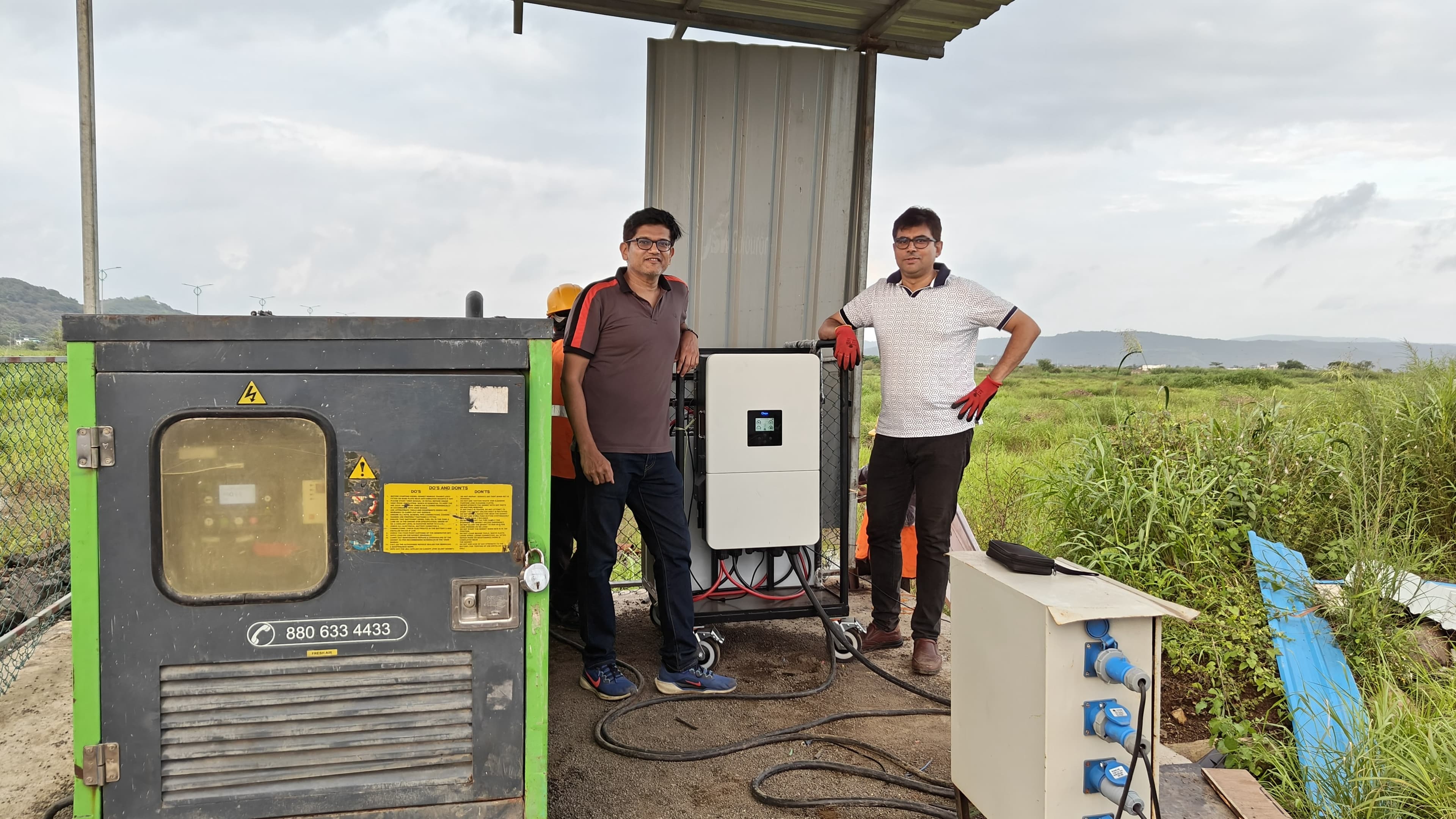
SmartBatt co-founders at the JNPA site — the 20kW/40kWh BESS unit (IP65-rated, centre) installed outdoors alongside the 30 KVA diesel generator (left). No shelter or enclosure required.
24×7
Power Availability
vs. 12–14 hrs before
~20%
Monthly Cost Saving
vs. 62 KVA DG alone
3.5 T
CO₂ Avoided
over 6-month deployment
−25%
DG Runtime Reduced
10 hrs/day vs. 12–14 hrs
Client Context
A leading infrastructure contractor was building a large warehousing facility at Jawaharlal Nehru Port (JNPA), Navi Mumbai — one of India's busiest logistics hubs. The project site comprised six to seven porta cabins serving as site offices, workstations for engineers, meeting rooms, a pantry, toilets, and a storage unit.
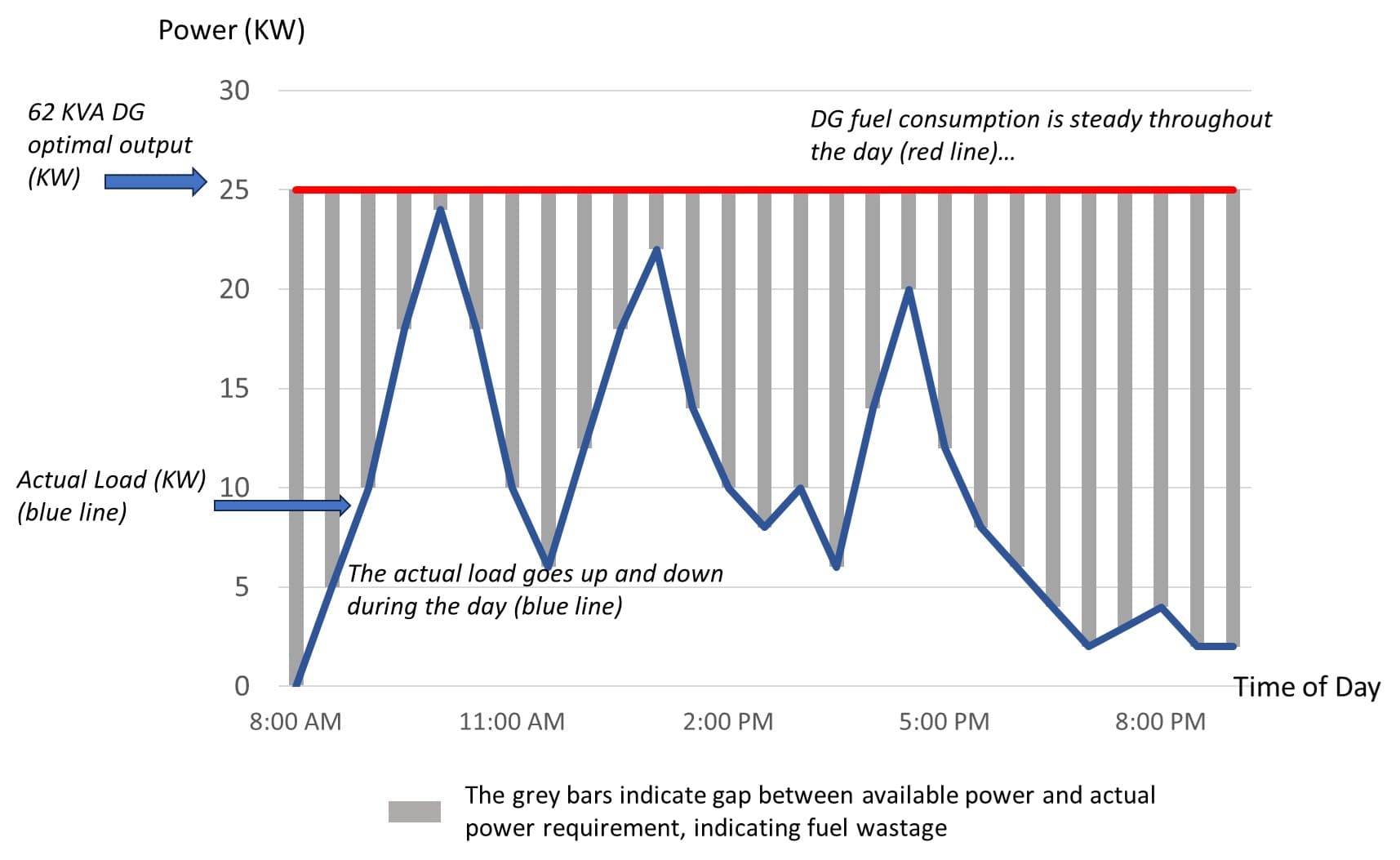
With no grid connection and no solar infrastructure on site, a 62 KVA diesel generator was the sole power source — running 12 to 14 hours a day. After 9–10 PM, the site went completely dark: a meaningful operational and security concern for a live construction project running over multiple months.
The Challenge
No grid power on site
The site depended entirely on a 62 KVA diesel generator — with full exposure to fuel price volatility, supply logistics, and operator availability.
Limited operating hours
The DG ran from 8 AM to 9–10 PM. After that, the site had no power — no lighting, no CCTV, no connectivity.
Overnight security risk
Cameras and perimeter lighting went offline every night, leaving a large construction site completely unmonitored through the dark hours.
Oversized and inefficient DG
A 62 KVA generator was substantially oversized for the site's average load, running at low utilisation for much of the day — burning fuel inefficiently.
Peak load stress mid-afternoon
When ambient temperatures peaked and air-conditioning loads surged across multiple cabins simultaneously, the DG was pushed to capacity with limited headroom.
Emissions and noise in a working environment
Continuous diesel combustion over 12–14 hours contributed to on-site air quality degradation and noise in an occupied office environment.
The SmartBatt Solution
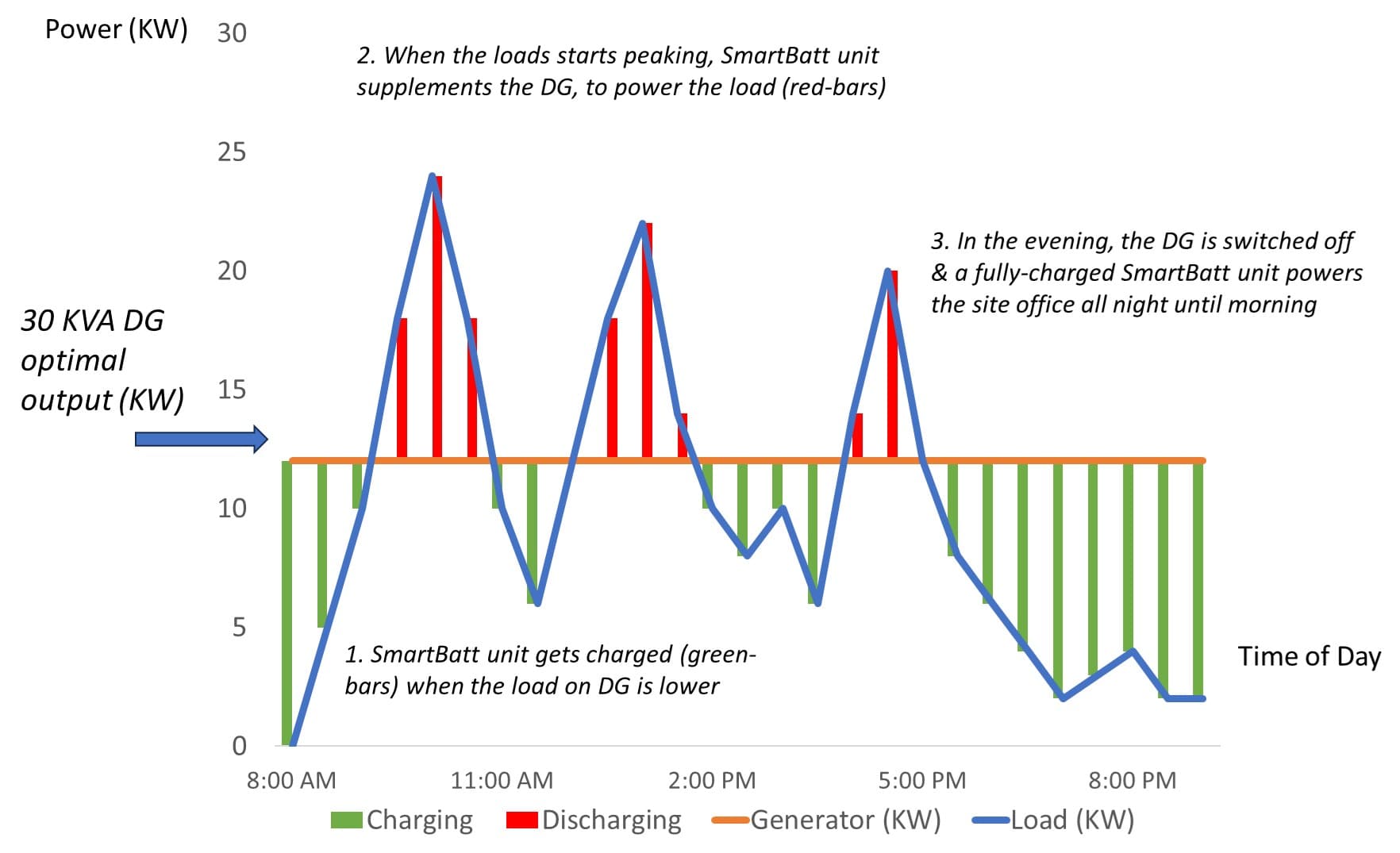
SmartBatt conducted an on-site power audit to map the load profile across the day. Based on this, the 62 KVA DG was replaced with a 30 KVA unit, and a SmartBatt 20 kW / 40 kWh BESS unit was deployed alongside — coordinated in a charging and peak-shaving cycle through the day.
IP65 Rated for Outdoor Deployment — The SmartBatt unit is fully protected against dust ingress and water jets, making it suitable for open-air installation with no additional shelter or enclosure required. At the JNPA site, the unit was mounted outdoors directly alongside the DG.
Daily Operating Cycle
9 AM – 12 PM
DG: ON (30 KVA)
Charging
DG powers cabins at low morning load while simultaneously charging the SmartBatt unit.
12 PM – 5 PM
DG: ON (30 KVA)
Peak Shaving
As AC loads surge in the afternoon heat, SmartBatt supplements the DG — handling demand the 30 KVA unit alone couldn't support.
5 PM – 6 PM
DG: ON (30 KVA)
Re-charging
As load eases toward evening, the DG re-charges the battery to prepare for the overnight window.
6 PM – 9 AM (next day)
DG: OFF
Overnight on Battery
The entire site load — CCTV, perimeter lighting, fans, refrigerator — runs on SmartBatt for 15 uninterrupted hours. DG is silent.
The DG ran for only 10 hours per day — and was off entirely from 6 PM to 9 AM — while the site maintained uninterrupted power throughout the night.
How Peak Shaving Works
As-Is — 62 KVA DG only
Proposed — 30 KVA DG + SmartBatt
Equipment Powered
Before vs. After
Cost figures are directional. Actual savings vary based on diesel prices, DG vendor terms, and site-specific load profile.
| Parameter | Before | After | Change |
|---|---|---|---|
| DG Size | 62 KVA | 30 KVA | 52% smaller DG |
| Power Availability | 12–14 hrs/day | 24 hrs/day (continuous) | Full coverage |
| DG Runtime | 12–14 hrs/day | 10 hrs/day | ~25% less DG use |
| Fuel Consumption | ~4 L/hr | ~3 L/hr | ~220 L/month saved |
| Monthly Energy Cost | Higher baseline | ~15–20% lower | Net cost saving |
| Night Security | No power after 9–10 PM | Cameras & lights 24×7 | Site secured |
| Peak Load Handling | DG size constrained | SmartBatt peak shaving | No load shedding |
| Emissions | 62 KVA × 13 hrs/day | Significantly reduced | ~3.5 T CO₂ over 6 months |
Impact Delivered
Commercial Impact
The shift from a 62 KVA DG at 12–14 hours to a 30 KVA DG at 10 hours — combined with the SmartBatt monthly rental — resulted in a total monthly energy spend approximately 15–20% lower than the prior arrangement, while delivering continuous 24×7 power vs. the previous 12–14 hour window. A smaller DG attracts roughly half the monthly rental of a 62 KVA unit; lower utilisation also means less fuel per hour. The SmartBatt charge, set against these combined savings, produced positive net economics from day one.
Environmental Impact
Prior: 62 KVA × 4 L/hr × 13 hrs/day = ~52 L/day
New: 30 KVA × 3 L/hr × 10 hrs/day = ~30 L/day
Diesel avoided: ~22 L/day × 30 days = ~220 L/month
CO₂ factor: 1 litre ≈ 2.68 kg → ~590 kg CO₂/month
Over 6 months: ~3,540 kg CO₂ not emitted (≈ 3.5 tonnes)
Equivalent to taking a mid-size petrol car off the road for approximately 6 months. Beyond CO₂, reduced DG runtime also cut PM2.5, NOx, and SO₂ in an occupied working environment.
Operational Impact
- ✓24×7 power continuity — site moved from a fixed 12–14 hour window to uninterrupted round-the-clock availability
- ✓Security restored — CCTV cameras and perimeter lighting ran through the night, eliminating the overnight blind spot
- ✓Peak load managed without oversizing — mid-afternoon AC loads absorbed by SmartBatt; no need to return to a larger DG
- ✓Reduced generator wear — DG now runs 10 hrs/day vs. 12–14 hrs, extending service intervals
- ✓Outdoor installation, no shelter needed — IP65 rating meant the unit could be mounted in the open alongside the DG without any enclosure
- ✓Quieter site environment — 15 hours of DG-off overnight operation reduced noise and diesel exhaust for on-site personnel